Milwaukee architecture presents distinct harborages for urban wildlife, particularly the cold-lakefront microclimates and mature rooflines found in historic properties. Raccoons frequently exploit rotted soffits and…
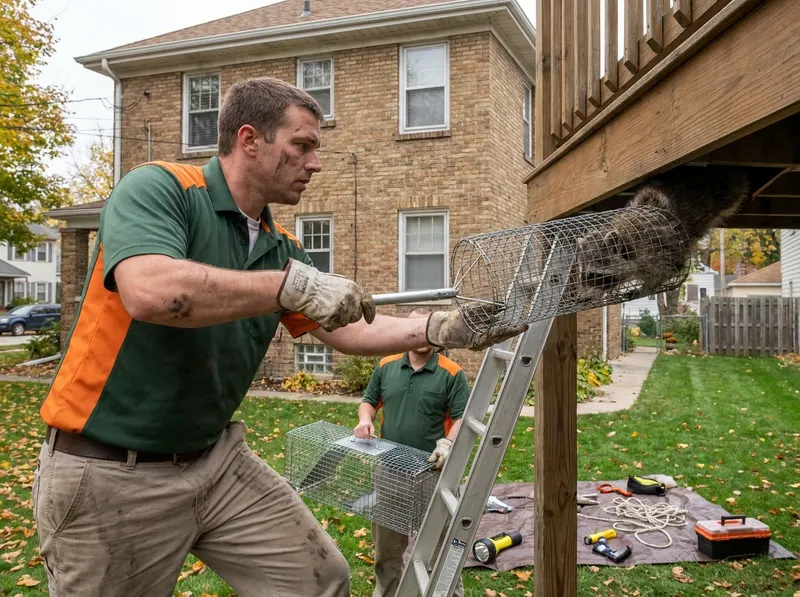
Milwaukee architecture presents distinct harborages for urban wildlife, particularly the cold-lakefront microclimates and mature rooflines found in historic properties. Raccoons frequently exploit rotted soffits and fascia boards along older Lake Park and Brewers Hill Victorians, pulling back cedar trim to access insulated attic cavities. In high-density rental duplexes throughout Riverwest and Bay View, eastern gray squirrels routinely gnaw through unbacked gable louvers, compromising electrical wire sheathing and loft insulation. Striped skunks and opossums favor the crawlspaces beneath raised porches, rear additions, and stone foundations typical in Sherman Park and Washington Heights, tracking damp earth into subfloors. Physical barrier construction stops these animal incursions where simple broadcast poisons or chemical deterrents fail, securing building envelopes without environmental contamination.
Effective defense prioritizes biological exit patterns over continuous containment trapping. Installing 16-gauge galvanized hardware cloth over openings paired with a mechanical one-way door allows target wildlife to vacate attic or sub-roof zones naturally while preventing re-entry. In brick commercial properties and mixed-use lofts across the Historic Third Ward and Walker's Point, small brown bat colonies enter mortar gaps as narrow as 3/8 inch near roof junctions; these operations require precise temporal exclusion following Wisconsin Department of Natural Resources bat roosting windows, avoiding mother-pup separation periods. Trapping alone without perimeter fortification creates an open structural vacuum, leaving chimney caps, roof junctions, and foundation voids accessible to neighbouring litters within weeks.
1. Property assessment maps all roofline transitions, dormers, foundation vents, and active entry points across the structure.
2. One-way eviction funnels or humane live capture cages are positioned directly along confirmed animal runways.
3. Technicians extract trapped wildlife in accordance with local municipal regulations and Wisconsin DNR statutes.
4. Damaged soffits, roof vents, and crawl gaps receive custom-bent 1/4-inch to 1/2-inch steel mesh and weather-rated flashing.
5. Contaminated attic or crawlspace substrates undergo localized bio-enzymatic treatment to neutralize animal pheromone scent trails.
Every job gets a firm, written price after a free on-site visit.
Tell us about your wildlife removal job in Milwaukee and we'll send a clear, written quote, usually the same day.
 Rasteno Pest Specialists