Milwaukee properties face two primary structural ant threats driven by Lake Michigan humidity and older wood construction: moisture-seeking carpenter ants and kitchen-infesting pavement or odorous house ants. In…
Milwaukee properties face two primary structural ant threats driven by Lake Michigan humidity and older wood construction: moisture-seeking carpenter ants and kitchen-infesting pavement or odorous house ants. In neighborhoods with historic wood framing like Washington Heights, Brewers Hill, and Sherman Park, carpenter ants excavate galleries through moist subfloors, porch footings, and window headers compromised by freeze-thaw condensation. Because carpenter ants do not consume wood but hollow it out for nesting, sawdust-like frass containing insect fragments accumulates along basement sills and baseboards. Pavement ants frequently emerge through slab expansion joints, basement foundation cracks, and brick paver walkways in Walker's Point and the Historic Third Ward, foraging directly into food preparation counters and pantries.
Effective ant remediation relies on non-repellent transfer agents and species-specific baiting matrices rather than over-the-counter pyrethroid surface sprays. When exposed to fast-acting retail repellents, odorous house ants and pharaoh ants undergo budding, a survival response where the stressed colony fragments into multiple satellite queens, turning a single kitchen trail into multi-room infestations across adjoining duplex units in Riverwest or Bay View. Professional applications utilize slow-acting fipronil or indoxacarb compounds. Worker ants walk through treated exterior zones and consume protein- or sugar-based baits, transporting active micro-doses back into deep wall voids to eliminate reproductive queens through grooming and regurgitation within 10 to 14 days.
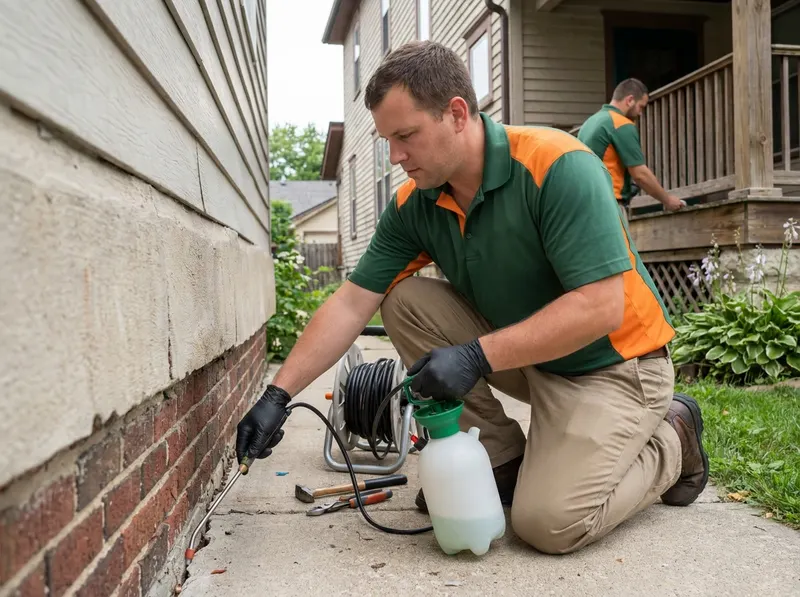
Exterior exclusion provides the long-term defense against re-infestation along the damp Milwaukee River corridor and near Lake Park. Overhanging tree canopies, deteriorating wood trim, and utility line penetrations serve as aerial bridges for foraging trails bypassing ground barriers. Technicians apply an exterior liquid residual barrier extending 36 inches up the exterior masonry and 36 inches outward along the soil perimeter, accompanied by localized siliconized acrylic sealing around wire conduits, gas pipes, and ground-level sill plates. The trade-off between exterior perimeter defense and deep void injection is seasonal access: wet or freezing spring conditions prioritize interior wall void micro-dusting and target baiting, while summer requires active structural perimeter barriers to halt satellite nest expansion before autumn migration.
Every job gets a firm, written price after a free on-site visit.
Tell us about your ant control job in Milwaukee and we'll send a clear, written quote, usually the same day.
 Rasteno Pest Specialists